JOIN GEOSHARE
Please Buy Less Geotechnical Instruments

At first glance, it may seem like a strange message from a company involved in geotechnical instrumentation and monitoring: please buy less geotechnical instruments.
After all, the industry often focuses on instrument counts, monitoring specifications, and ever-larger data sets. It is easy to assume that if ten instruments are good, then twenty must be better. The reality is more complicated.
In many projects, additional instruments can increase cost, complexity, installation risk, data management requirements, and ultimately confusion. The most successful monitoring schemes are not necessarily the largest. They are the schemes that answer the right questions and provide decision-makers with meaningful, reliable information.
The objective should never be to install the maximum number of instruments possible. The objective should be to generate the insights needed to manage risk effectively.
The “More Is Better” Trap
When concerns exist about ground behaviour, structural performance, or construction risk, the natural response is often to add more monitoring points. Sometimes this is justified. However, many organisations fall into the trap of believing that uncertainty can always be solved by purchasing additional sensors. In practice, this can create new problems:
- Increased installation costs
- More complex data management
- Greater maintenance requirements
- Higher risk of installation errors
- Larger volumes of data with limited additional insight
- Difficulty identifying what information is truly important
It is not uncommon to see projects producing thousands of data points every day while still struggling to answer basic questions about performance and risk. The problem is rarely a lack of data. More often, it is a lack of clarity regarding what data is actually needed.
Start With the Question, Not the Instrument
A well-designed monitoring programme begins by asking:
- What are we trying to protect?
- What are our key risks?
- What behaviour are we expecting?
- What behaviour would indicate a developing problem?
- What information is required to make decisions?
Only once these questions are answered should instrumentation selection begin. Unfortunately, the process is often reversed. A specification may call for a particular number of piezometers, inclinometers, settlement points, or strain gauges because a previous project used them. The instrumentation becomes the starting point rather than the outcome of the engineering assessment. The result is frequently a monitoring scheme that collects data without necessarily providing insight.
Every Instrument Should Have a Purpose
A useful principle is that every instrument should be able to answer a specific question. For example:
- A piezometer might be installed to verify that groundwater pressures remain within a predicted range.
- An inclinometer might be installed to confirm that lateral movement is occurring within acceptable limits.
- A load cell might be installed to validate the performance of a support system.
If the project team cannot clearly articulate why an instrument is being installed, it is worth questioning whether it is needed at all. More instruments do not automatically improve understanding. Purposeful instruments do.
Data Overload Is a Real Risk
Modern automated monitoring systems can collect enormous quantities of information. While this capability is valuable, it creates another challenge: data overload.
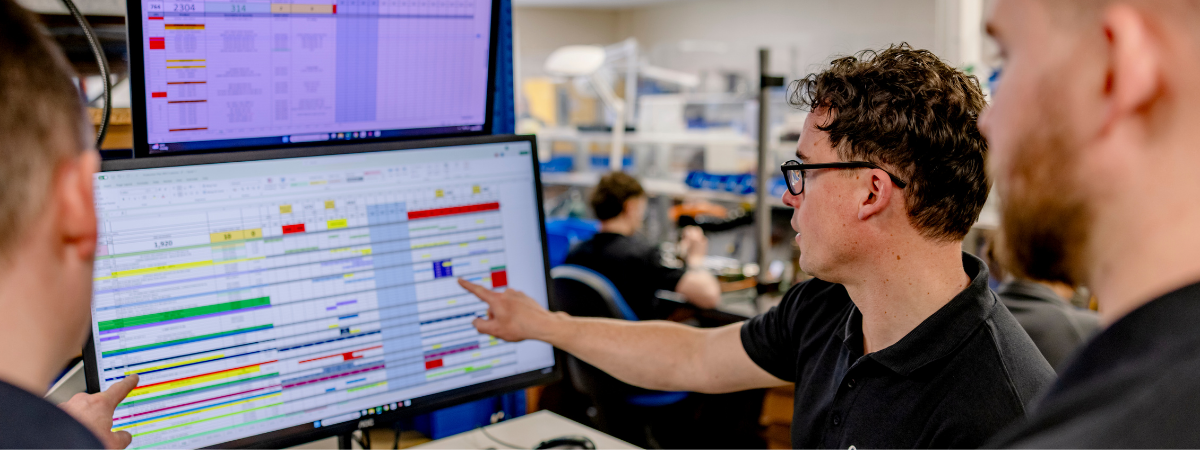
Engineering teams can quickly become overwhelmed by dashboards, reports, alerts, and spreadsheets. Important trends become hidden amongst large volumes of routine information. The consequence is that critical signals may be missed because they are buried in a sea of data.
A smaller, carefully planned monitoring network often provides better visibility than an oversized network generating excessive information. The goal should be actionable intelligence, not simply the largest available dataset.
Better Installation Often Delivers Greater Value
Many monitoring failures occur not because insufficient instruments were installed, but because the installed instruments were not implemented correctly. Common issues include:
- Poor installation practices
- Inadequate commissioning
- Incorrect cable protection
- Incomplete baseline readings
- Lack of calibration verification
- Poor data interpretation procedures
Investing in installation quality, training, competency, and data interpretation frequently delivers more value than simply increasing instrument quantities. Ten well-installed instruments are far more useful than twenty poorly installed ones.
Focus on Outcomes, Not Quantities
The most effective monitoring programmes are designed around outcomes. They help project teams:
- Reduce uncertainty
- Improve safety
- Validate design assumptions
- Manage construction risk
- Optimise maintenance decisions
- Demonstrate regulatory compliance
None of these objectives are achieved by instrument quantity alone. Success comes from deploying the right instruments, in the right locations, installed correctly, and analysed by competent people.
When You Should Buy More Instruments
Of course, there are situations where additional instrumentation is absolutely justified. More instruments may be required when:
- Project risks increase
- Consequences of failure are severe
- Greater redundancy is necessary
- Regulatory requirements demand wider coverage
- Engineering models require further validation
- Existing monitoring reveals unexpected behaviour
The point is not that fewer instruments are always better. The point is that instrumentation should be driven by engineering need, not by a desire to maximise sensor counts.
The Real Value of Monitoring
The purpose of geotechnical monitoring is not to create data. The purpose is to improve understanding and support better decisions. A single instrument that clearly identifies an emerging risk can be worth more than hundreds of sensors producing information that nobody uses. So yes, from a monitoring specialist’s perspective, our advice may sound unusual:
Please buy less geotechnical instruments.
Just make sure the ones you do buy are the right ones. Because effective monitoring is not measured by the number of instruments installed. It is measured by the quality of the decisions they enable.
Page Contents
Share this article